Disability Ramps for Home Australia: The Complete Guide
A disability ramp is one of the most practical home modifications for wheelchair users or people with limited mobility. This guide covers everything you need to know about buying or installing a ramp in Australia — costs, standards, and NDIS funding.
Do I Need a Disability Ramp?
- Steps at the front entry — ramp provides level access
- Split-level home, main living area up a few steps
- Backyard access for garden or pool area
- Garage-to-home entry with a step or threshold
Ramps help with wheelchairs, walkers, prams, and reduce fall risk for anyone unsteady on their feet.
Types of Disability Ramps


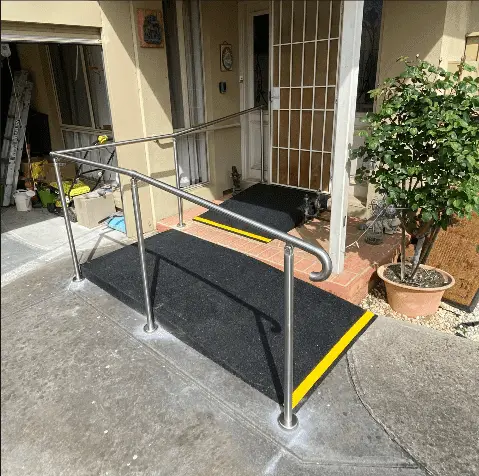
| Type | Price Range | Best For |
|---|---|---|
| Threshold ramp | $30 – $200 | Single step or door threshold |
| Folding portable ramp | $150 – $800 | Travel, visiting |
| Modular aluminium ramp | $500 – $4,000 | Standard home entry |
| Custom wooden ramp | $500 – $3,000 | Matching house aesthetic |
| Powered platform lift | $12,000 – $25,000 | Steep or heritage entries |
Popular brands: Moran, EZ-ACCESS, Portaramp. REDI Electric powered ramps are gaining popularity.
Australian Standards (AS 1428)
- Gradient: Max 1:14. 1:20 preferred for manual wheelchairs
- Width: Min 1,000mm between handrails
- Handrails: Both sides if rise > 190mm
- Landings: Level platform top and bottom, min 1,200mm
- Curbs: 50-100mm kerb rails on open sides
NDIS Funding for Ramps
- OT assessment of home access needs
- OT specifies ramp type, length, configuration
- Written quote from NDIS-registered supplier
- Quote reviewed and approved by NDIS planner
- Installation
Temporary ramps (post-surgery) may be funded under consumables. Permanent ramps are capital supports.
Need a Ramp for Your Home?
We connect you with local ramp specialists. Free quotes and consultation.
Browse by city:
Ramp vs Platform Lift
Small steps + enough horizontal space → ramp. Steep entry where 1m height = 14m ramp → platform lift.
FAQ
Can I claim a disability ramp on NDIS?
Yes, with OT assessment confirming need.
What's the maximum slope?
AS 1428: maximum 1:14 gradient. 1:20 more comfortable.
Do I need council approval?
Most modular ramps don't. Heritage properties do.
How long does installation take?
Modular: 1-2 days. Custom wooden: 2-5 days.
Can ramps be hired?
Yes — $50–$150 per week from mobility suppliers.
Get a Free Consultation
Tell us about your needs and we'll connect you with local specialists.
Get a Free Home Modification Consultation
Not sure which solution is right for you? We'll connect you with trusted specialists in your area for a free, no-obligation consultation.
Official NDIS Sources
-
NDIS — What are home modifications
ndis.gov.au/participants/home-and-living/modifying-your-home/what-are-home-modifications -
NDIS — Guide to providing home modifications
ndis.gov.au/providers/home-and-living-providers/home-modifications/guide-providing-home-modifications -
NDIS — How to provide a home modification assessment
ndis.gov.au/providers/home-and-living-providers/home-modifications/how-provide-home-modification-assessment
Frequently Asked Questions
How much does a disability ramp cost in Australia?
Portable aluminium ramps cost $119-$500 depending on length. Modular ramp systems range from $1,500-$8,000 installed. Custom concrete ramps cost $3,000-$10,000+. NDIS funding may cover the full cost if deemed reasonable and necessary for your disability needs.
What is the maximum ramp gradient allowed in Australia?
Under Australian Standard AS 1428.1, the maximum gradient for an accessible ramp is 1:14 (1 metre rise per 14 metres length). A steeper gradient of 1:10 is only permitted for ramps under 1.9m. Handrails are required on both sides when the ramp exceeds 190mm in rise.
Can I get NDIS funding for a home wheelchair ramp?
Yes. Wheelchair ramps are commonly funded under NDIS Home Modifications. You need an Occupational Therapy assessment that confirms the ramp is reasonable and necessary. Your NDIS plan must include funding for Home Modifications (typically up to $15,000 for high-cost modifications).
What types of disability ramps are available in Australia?
The main types are: portable aluminium ramps (threshold access), modular ramps (custom length, no concrete), permanent concrete ramps (most durable), and prefabricated steel ramps. The right choice depends on your home, budget, NDIS plan, and whether you rent or own.